HAND GESTURE AND ACTIVITY RECOGNITION IN ASSISTED
LIVING THROUGH WEARABLE SENSING AND COMPUTING
Videos can be found at http://goo.gl/PcBO8
|
Background
Human-robot interaction (HRI) is a very important issue in the design of assistive robotics, especially for elderly people, who usually suffer from problems with speech, or have difficulty in learning new computer skills. It is desirable to make the robot able to not only understand explicit human intentions from gestures, but also recognize the human daily activities, from which implicit human intentions may be inferred. Such a robot capability is called considerate intelligence. |
||
|
Goal
We focus on daily human activity recognition in the SAIL system using wearable inertial sensors. We have developed a new motion sensor node using a commercial VN-100, as shown in Figure 2 (a, b, c). The node sends data through Zigbee to a receiver on the PC for processing. ZigBee is one type of short-distance wireless communication standards, which is used for wireless networking range of 10-20 meters mainly in home and offices. Each motion sensor node has an ID to be distinguished from others. Therefore, multi-person activity can also be tracked in this system. In this project, we have three channels of sensor measurements: body motion data, hand motion data, and the location information. Limited number of sensors will increase the difficulty of distinguishing the basic daily activities due to the inherited ambiguity. Therefore, we use a minimum setup of the wearable sensor system, which includes three inertial sensors, to recognize both hand gestures and body activities. Three wireless inertial sensors are attached on the right thigh, waist and the right wrist of the human subject to collect body and hand motion data. We have solved the following problems: 4. We developed a dynamic Bayesian network-based approach to recognize human complex daily activities (body activities and hand gestures simultaneously) in a mock apartment. Three wireless motion sensors are worn on the right thigh, the waist, and the right hand of the human subject to provide motion data; while an optical motion capture system is used to obtain his/her location information. A three-level dynamic Bayesian network is implemented to model the intra-temporal and inter-temporal constraints among the location information, body activities and hand gestures. The body activity and hand gesture are estimated online using the short-time Viterbi algorithm. This approach has the advantage of reducing the obtrusiveness and the complexity of vision processing, while maintaining high accuracy of activity recognition. 5. We proposed a coherent framework to detect multiple types of anomalies in human’s daily life. Four types of abnormal behaviors: spatial anomaly, timing anomaly, duration anomaly and sequence anomaly, can be detected in realtime. The anomaly detection module can be integrated into the assisted living system, in which complex activities can be recognized and multiple types of anomalies can be detected. | ||

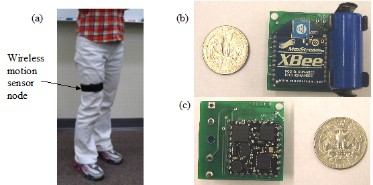
Fig. 2 Sensor setup.
